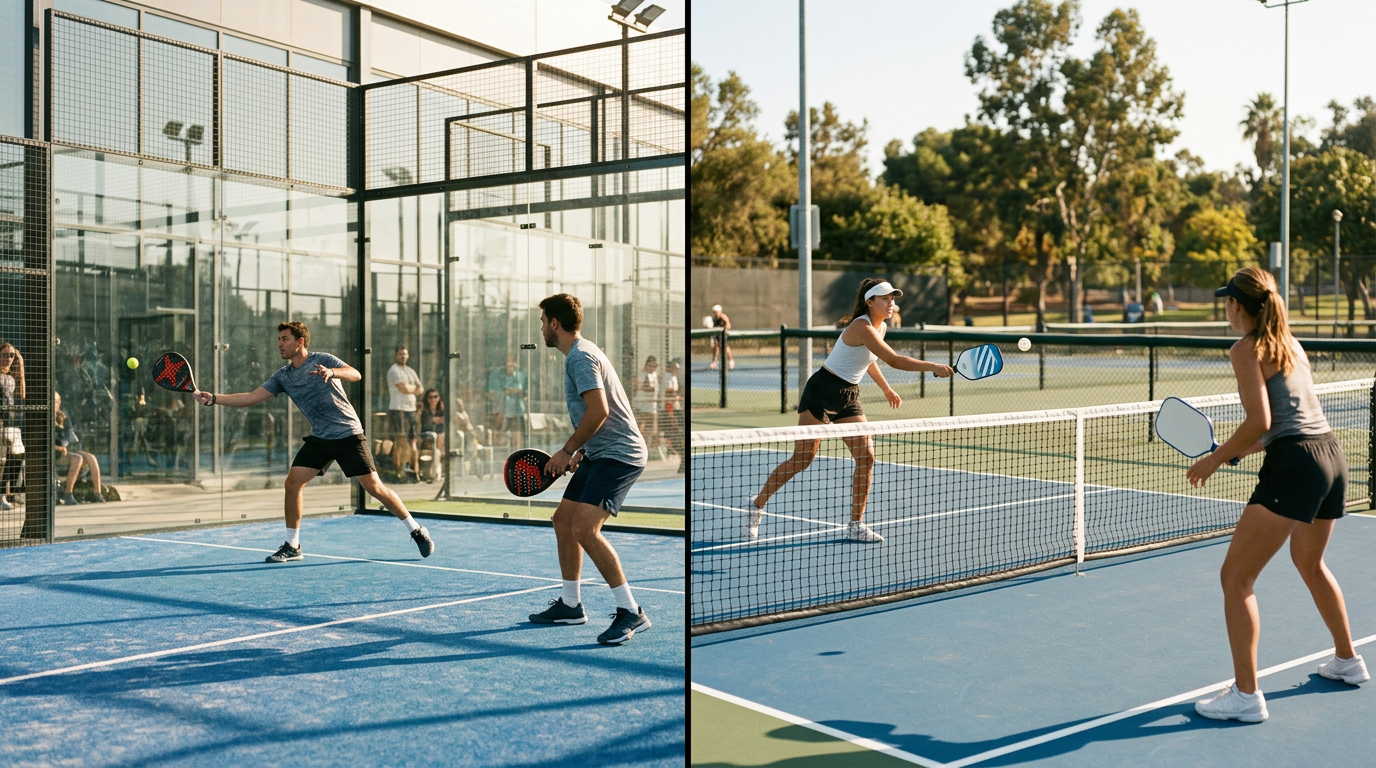
They're both fast-growing. Both played with a solid paddle rather than a strung racquet. Both accessible to beginners and genuinely enjoyable from the first session. If you've heard of one, you've probably heard of the other - and if you've tried one, someone has almost certainly suggested you try the other.
So what actually separates them? Quite a lot, as it turns out.
Quick answer: Both are great sports. Padel is played in a glass-walled enclosed court and the walls are part of the game. Pickleball is played on an open court, anywhere, with anyone. Very different experiences.
The court
This is the most immediate difference, and the one that shapes everything else.
Padel is played in an enclosed glass and metal court, roughly the same width as a tennis court but shorter. The walls are part of the game - players use them deliberately, playing shots off the back and side glass in the same way a squash player uses the walls. The enclosure is central to the sport's identity. You can't play padel without it.
Pickleball is played on an open court - no walls, no enclosure. Smaller than a tennis court, with a low net and clear boundary lines. Anywhere with a suitable floor and enough space can host it: leisure centres, school sports halls, community centres, tennis clubs. That flexibility is a big part of why pickleball has spread so quickly across the UK.
How the game is played
Padel borrows heavily from tennis. The scoring system is identical - love, fifteen, thirty, deuce, advantage, games, sets. The walls introduce a strategic layer that takes time to understand and longer to use well. It's a fast, dynamic game that rewards aggression and movement.
Pickleball is its own thing. Points are scored only by the serving team. Games go to eleven, win by two. The kitchen prevents players from dominating at the net through power alone. The game rewards patience and placement as much as speed and athleticism. Rallies can be long, tactical, and surprisingly nuanced even at recreational level.
Padel rewards aggression. Pickleball rewards patience. Both are genuinely enjoyable - but they attract slightly different personalities once players develop a preference.
The learning curve
Both sports are accessible - but in different ways.
Padel takes a session or two before the walls start to feel like an asset rather than a surprise. Until that clicks, shots coming off the glass can feel disorienting. The tennis scoring system is familiar to many players, which helps - but the wall play introduces a genuine adjustment period.
Pickleball clicks faster. The court is simpler, the ball moves slower, and most beginners are in a proper rally within the first fifteen minutes of their first session.
The social experience
Both sports have strong social cultures. Both are almost always played as doubles. The difference is in how sessions are typically structured.
Padel sessions tend to be organised around fixed groups of four - you book a court, bring your players, and play together. It's sociable within your group, but it requires that group to exist before you arrive.
Pickleball sessions are more commonly set up with a rotation system. Players mix throughout the evening, switching partners and opponents as games finish. You can turn up alone and be part of something within minutes. The social layer builds automatically rather than requiring organisation.
Which one should you try?
If you enjoy fast-paced, dynamic play and the idea of using walls as part of your tactics appeals to you, padel is worth trying. The enclosed court creates a particular kind of intensity that a lot of players love.
If you want something you can get into quickly, play socially without needing to organise a group, and enjoy at any level from the first session - pickleball is the easier starting point.
Many players end up doing both. But if you're only starting with one, pickleball tends to deliver that first proper game faster - and that first game has a habit of leading to many more.
Find a pickleball court near you on The Pickleball Directory | The Home of UK Pickleball and see for yourself.


.avif)


.png)
.png)