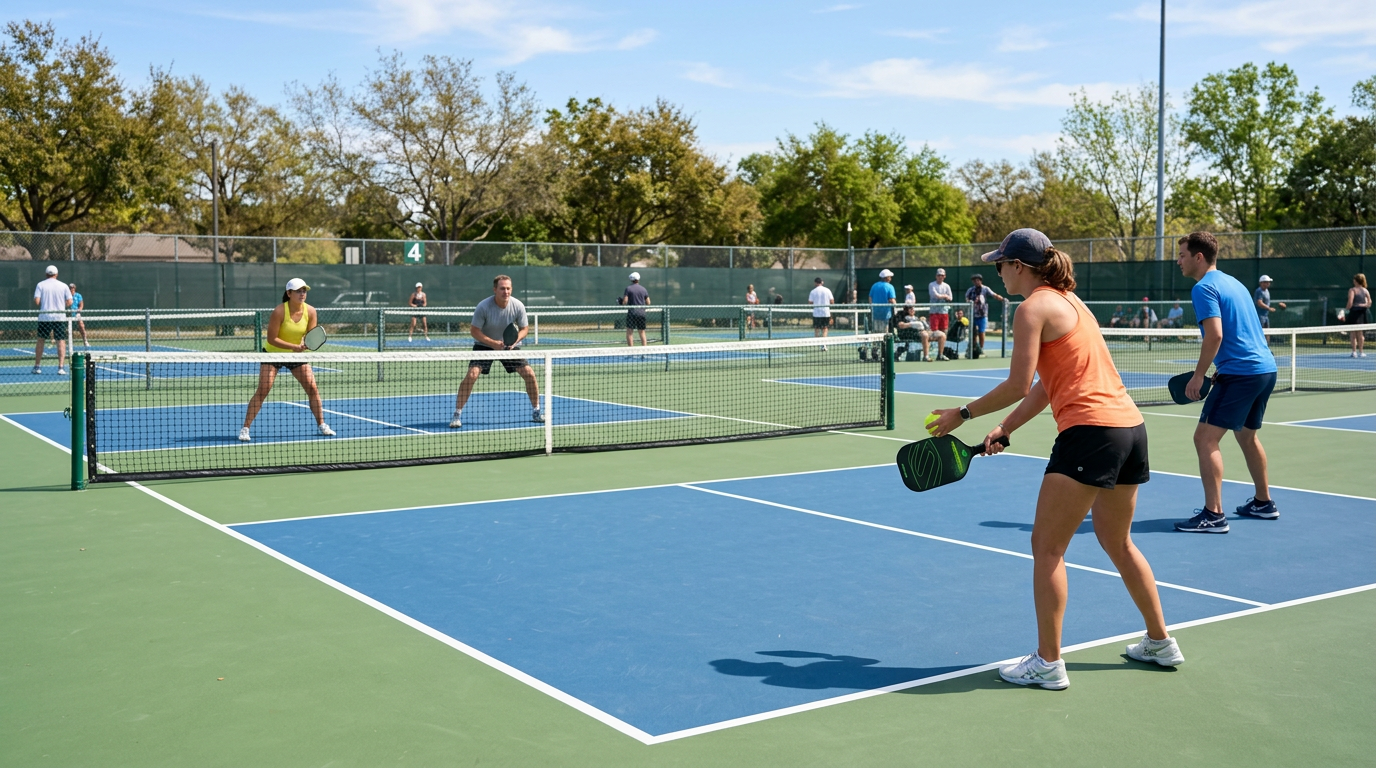
Pickleball scoring confuses almost everyone at first. Not because it's complicated - it isn't - but because it's slightly different from anything you've probably played before. Give it a few games and it clicks completely. Until then, here's everything you need to know.
The basics
Games are typically played to 11 points, win by 2. If the score reaches 10-10, play continues until one side leads by two clear points.
Tournament games are sometimes played to 15 or 21, but for recreational and club sessions, 11 is the standard. Games move quickly - faster than most people expect - which is part of what makes pickleball so easy to fit into an evening.
You can only score when you're serving
This is the part that catches most beginners. In pickleball, you can only win a point when your side is serving. If the receiving team wins the rally, they don't score - they win the serve instead.
It means momentum can shift quickly and quietly. A team can spend several rallies building a lead, then lose the serve and score nothing for a while. Leads feel less safe than in other sports, which keeps games interesting right until the end.
How serving works in doubles - and why there are three numbers
In doubles, both players on the serving team get a chance to serve before the serve passes to the other side. When the first server loses a rally, the serve passes to their partner. When that player loses a rally, the serve passes to the other team entirely.
To track all of this, the score in doubles is called as three numbers:
- First number — serving team's score
- Second number — receiving team's score
- Third number — whether it's the first or second server
So "4-3-2" means the serving team has 4 points, the receiving team has 3, and it's the second server's turn. Heard mid-game it makes complete sense, and after a few matches you stop thinking about it entirely.
The start-of-game exception
At the very start of a game, the first serving team only gets one server before the serve passes to the other side. This stops the serving team from building too big an advantage right at the beginning.
To signal this, the first server of the game calls the score as "0-0-2" — meaning it's already the second server, even though no one has served yet. It sounds odd written down. In practice, it's a detail you hear once and never forget.
Singles is simpler
In singles, the third number disappears. There's only one server per side, so the score is just two numbers - your score and your opponent's. Everything else works the same way.
Calling the score
In most recreational games, the server calls the score out loud before each serve. This keeps everyone on the same page and avoids the quiet disagreements that slow a game down. If you're not sure of the score, just ask. No one minds.
How it feels in practice
The honest truth is that scoring feels slightly awkward for the first game or two, and then it doesn't at all.
Most beginners find the two-server rule the trickiest part to track early on. The simplest approach is to listen to what the server calls before each point and trust the number. You don't need to keep an independent count in your head - stay present and let the serve tell you where things stand.
After a few sessions, you'll be calling the score yourself without thinking about it. That's usually the moment you realise you've properly got the hang of the game.
The short version
- Games to 11, win by 2
- Points only scored by the serving team
- In doubles, each team gets two serves before the serve changes
- Score called as three numbers in doubles, two in singles
- The first serving team of the game starts on server two (0-0-2)
That's the whole system. It's more intuitive than it reads - a couple of games and it becomes second nature.
Ready to try it out? Find a pickleball court near you on The Pickleball Directory | The Home of UK Pickleball.


.avif)


.png)