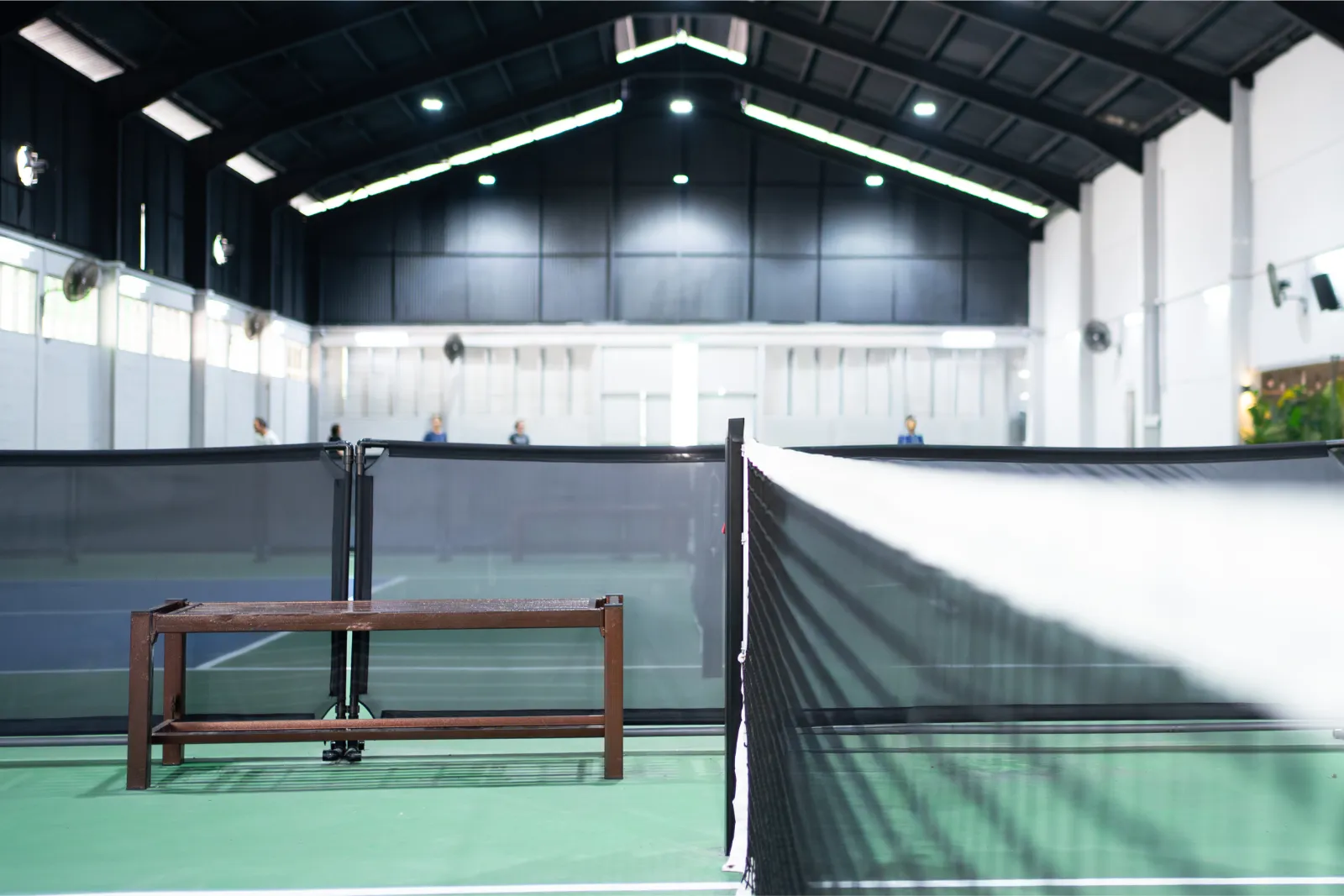
Indoor badminton court with net and empty bench under bright overhead lights.

BUILD YOUR PICKLEBALL COURT

There are still nowhere near enough pickleball courts in the UK - and the sport is growing faster than venues can keep up. The good news? You probably already have access to a space that can become one.
Whether you manage a sports hall, run a school PE programme, want to convert a tennis court in your local park, or you've got space in your garden - this is the only guide you need. No jargon. No unnecessary complexity. Just what actually works in the UK.

Court Dimensions

Before anything else - here are the numbers that matter. A pickleball court has a unique shape that most people don't expect. Once you understand these, every conversion becomes obvious.

Know this first

Official court Dimensions

Before you build, convert or book — these are the numbers that matter. Tap any zone on the court or use the buttons below.

PREFERRED · 34ft × 64ft MINIMUM · 30ft × 60ft 10×15ft 10×15ft 10×15ft 10×15ft KITCHEN · 7ft KITCHEN · 7ft NET 36"/34" 20ft · 6.1m 44ft · 13.4m BASELINE BASELINE

Choose your space

What are you working with?

Every space is different. Tap your space below and we'll walk you through exactly what to do — step by step, with what you actually need to buy.

Badminton Court
The easiest and most common conversion. One court becomes one. Two become two.
1–4 HRS SETUPTEMPORARY OR PERMANENT
Tennis Court
One tennis court fits four pickleball courts. The biggest opportunity to grow the sport.
4 COURTS FROM 1POP-UP OR PERMANENT
Mini Tennis & Schools
Already in thousands of UK schools. The fastest way into a PE curriculum.
NEAR-ZERO COSTKS1–KS4 READY
Sports Hall & Leisure Centre
The gold standard for club and competitive play. Permanent markings, ideal surfaces.
PERMANENT SETUPREVENUE GENERATING
Garden, Driveway & Outdoor Space
Got hard-standing? You can play. From a chalk-and-net session to a full tarmac build.
UK WEATHER GUIDANCEPLANNING ADVICE INCLUDED
⚡ Temporary or permanent

Badminton Court Conversion

A standard singles badminton court is 6.1m × 13.4m — almost exactly the size of a pickleball court. It's the easiest and most common conversion in the UK.

Single Badminton → 1 Pickleball Court
01
Confirm your court size. A standard singles badminton court is 6.1m × 13.4m — the boundary lines become your pickleball boundary lines.
02
Mark the kitchen. Measure 2.13m from the net on each side and add a line across the full width. This is the only new line you need.
03
Mark the centre service line. Runs from the kitchen line to the baseline on each side — it does not cross through the kitchen.
04
Choose your lining method. Temporary tape or chalk for multi-sport halls, semi-permanent tape, or painted lines if you have permission and a dedicated space.
05
Set up your net. A badminton net won't work — the height and post spacing are different. Use a portable pickleball net. Takes 5 minutes.
06
Set net height. 91.4cm at the posts, 86.4cm at centre. Attach a centre strap if needed.
Double Badminton Hall → 2 Pickleball Courts
01
Lay both courts side by side, running the same direction, with at least 0.6m between them (1.5m+ preferred for safety).
02
Mark each court independently — kitchen lines, centre lines and boundaries for each.
03
Use two separate portable net systems. One net cannot span a double court width.
04
If the hall retains badminton lines, use a different tape colour for pickleball to avoid confusion.
Surface: Taraflex and sprung wood floors are excellent for pickleball — consistent bounce, joint-friendly. If the floor gets slippery, ensure players wear non-marking court shoes.
What it actually costs: £250–£650 with a portable net and basic tape lining. £1,000–£2,500 for a permanent, socketed installation with proper painted kitchen lines.
✓ What you need for this conversion
  • Portable pickleball net system (posts + net + centre strap)
  • Court tape or chalk liner for kitchen + centre lines
  • Pickleball balls — indoor rated for hard court surfaces
  • Paddles (minimum 4 for doubles)
  • Non-marking court shoes
  • Tape measure for accurate marking
⚡ Pop-up or permanent

Tennis Court Conversion

One tennis court fits four pickleball courts — the single biggest opportunity to grow the sport in UK parks, clubs and schools.

Option A — Pop-Up Session (Zero Commitment)
01
Bring a freestanding portable net system — no drilling, no fixings needed.
02
Use outdoor chalk or removable tape to mark kitchen lines only. The tennis baselines are close enough to serve as boundaries for social play.
03
Setup: 20–30 minutes. Pack-down: 10 minutes. Works on any dry tarmac or hard court surface.
Option B — 4-Court Permanent Conversion
01
Plan the layout. Two pairs of courts running end-to-end across the tennis court width, with a shared buffer zone in the middle.
02
Check the surface. UK outdoor tennis courts are usually tarmac with an acrylic coating — generally fine for pickleball. Pressure wash any moss or algae before painting lines.
03
Commission a sports line painter to mark all four courts in a contrasting colour to existing tennis lines. All pickleball lines are 5cm wide.
04
Install nets — either 4 portable freestanding nets, or permanent post sockets drilled into the tarmac. Permanent posts give the best playing experience.
05
Use outdoor-rated pickleball balls. Standard balls can crack below 10°C — essential for UK year-round play.
UK weather: A covered tennis court converts far better than an exposed one. If exposed, a simple windbreak on the long sides dramatically improves playability — tennis windshield fabric works well and is cheap.
What it actually costs: A pop-up session costs next to nothing beyond the net (£179–£349). A single set of pickleball lines painted onto an existing tennis court runs £200–£3,000. A full permanent 4-court conversion, including surfacing and posts, typically lands between £14,000–£30,000 — most of that is the outdoor surfacing and fencing work, which indoor conversions skip entirely.
✓ What you need for this conversion
  • Portable net systems ×4 (or permanent posts)
  • Outdoor court tape or line marking paint
  • Outdoor pickleball balls (rated for temperature)
  • Paddles ×4 minimum (×8 for 4-court simultaneous use)
  • Surface pressure wash if mossy or algae-covered
  • Windbreak fabric — optional but recommended for exposed courts
⚡ Instant setup · Schools focus

Mini Tennis & School Courts

Mini tennis courts are already in thousands of UK schools. They need almost no modification — the fastest way to introduce pickleball to a PE curriculum.

The 3-Step School Setup
01
Lower the existing mini tennis net to pickleball height — 91.4cm at the posts, 86.4cm at centre. Most mini tennis nets can be adjusted.
02
Add one kitchen line on each side. Measure 2.13m from the net and mark with chalk or tape. The only line that matters for beginners.
03
Hand out paddles and balls. Explain the kitchen rule and the scoring (first to 11, win by 2). That's it — they can play.
For PE teachers: Download our free lesson plans (KS1–KS4) from the Schools section — designed to fit a standard 60-minute PE lesson with no prior knowledge required. Pickleball works brilliantly for mixed-ability groups because the pace can be adjusted simply by choosing different ball types.
What it actually costs: Near-zero if you already have mini tennis courts — chalk lines are free, a basic tape kit costs a few pounds, and foam paddles for KS1/KS2 groups are inexpensive to buy in sets. The only real spend is paddles and balls.
✓ Your school pickleball checklist
  • Existing mini tennis court (Red or Orange size)
  • Net adjusted to pickleball height
  • Kitchen line marked with chalk or tape
  • Paddles — foam beginner paddles work for KS1/KS2
  • Pickleball balls or foam equivalents for younger groups
  • Lesson plan downloaded from the Schools section
★ Permanent · Professional setup

Sports Hall & Leisure Centre

The gold standard for club and competitive play — professional markings, permanent nets, ideal surfaces. For venues ready to commit to pickleball properly.

1
Plan your court layout
Get a floor plan and overlay your pickleball courts. A standard 4-court sports hall (33m × 18m) can typically fit 4–6 pickleball courts depending on orientation. Run courts parallel to the longer wall. Minimum run-off: 1.5m behind baselines, 1m between side-by-side courts.
2
Surface assessment
Sprung wood floors (Taraflex, Junckers, Haro) are ideal — consistent bounce, joint-friendly, great grip. Concrete floors are legal but hard on knees for older players; consider interlocking polypropylene sports tiles as an overlay.
3
Line marking
Commission a sports court line painter — not a DIY job for a permanent setup. All pickleball lines are 5cm wide. Paint in a clearly distinct colour, typically yellow or bright white. Allow 2–3 days for paint to cure.
4
Net systems
Permanent floor sockets give the best playing experience and no trip hazard. Wheeled net systems are more flexible for sharing between halls. For club-standard and above, permanent sockets are worth the investment.
5
Lighting — check your lux
Recreational play: minimum 300 LUX. Competitive/club play: 500 LUX+. Many UK sports halls built before 2000 have inadequate lighting for fast-paced pickleball.
6
Acoustics — the honest warning
Pickleball is louder than most indoor sports. The paddle-on-ball "pop" echoes significantly in halls with hard walls and ceilings. Worth flagging to neighbouring spaces before you start.
7
Signage, flow & first impressions
Court numbering, printed scoring guides at each net post, a warm-up zone, seating for rotation players. First impressions with new players are everything for growing a club.
8
What it actually costs
A portable-net setup with professional line marking (4-court hall) typically runs £2,000–£4,000. Go semi-permanent — socketed posts across all courts, full coordinated remarking — and budget £4,000–£8,000. Sports hall line marking alone ranges £300–£3,000 depending on court count and finish.
REVENUE MODELLING
A 4-court pickleball session (16 rotating players) generates more income per court than most other indoor sports sessions. Pickleball's social format drives longer dwell times and higher session frequency.
✓ Venue operator checklist
  • Floor plan reviewed and court layout confirmed
  • Surface assessed — suitable for pickleball
  • Line painter commissioned, colour agreed
  • Net system chosen (permanent or freestanding)
  • Lighting LUX checked at court level
  • Acoustic impact assessed
  • Court signage and rules guides prepared
  • Launch session planned — free come-and-try recommended
★ Build from scratch

Garden, Driveway & Outdoor Space

Got hard-standing? You can play. This covers everything from a chalk-and-net session to a full tarmac court build.

1
Measure & survey your space
You need at least 9.1m × 18.3m for a comfortable court with run-off. Absolute minimum for social play: 7m × 15m. Check for slope and drainage.
2
Choose your surface approach
Existing tarmac/concrete: clean, repair cracks, apply a coloured acrylic sports surface coating. New build: new tarmac base plus acrylic coating is most cost-effective. Paving slabs are not recommended.
3
Planning permission — England
In England, a hard-surface sports court in a private domestic garden typically falls under Permitted Development Rights, subject to standard outbuilding limits — height caps and not exceeding 50% garden coverage. Floodlighting usually needs a separate application. Conservation Areas and listed buildings remove permitted development rights. Always check with your Local Planning Authority.
4
Planning permission — Scotland, Wales & Northern Ireland
Scotland: generally permitted development under the same style of limits (height caps, 50% garden coverage). Fencing is capped at 2m (1m if it fronts a road), with no sport-specific exemption. Wales: mirrors England closely — outbuildings up to 50% garden coverage, 2.5m height cap within 2m of a boundary, and the same fencing height rules. Northern Ireland: outbuildings capped at 50% garden coverage and 4m height (2.5m eaves within 2m of a boundary); fences are governed separately and capped at 2m (1m near a road or footpath). All four nations: always confirm with your Local Planning Authority before starting work, especially near conservation areas or listed buildings.
5
Fencing — optional but recommended
A 2.5–3m surround fence keeps balls in play and improves the feel of the court. Chain-link or weld mesh is most cost-effective. Not required for casual play. Typical cost: £1,500–£4,000 depending on court size and fence height.
6
UK weather — the honest guide
Treat the surface annually with a fungicidal wash. Use outdoor-rated pickleball balls — standard balls can crack below 10°C. A windbreak significantly improves playability on exposed sites.
7
What it actually costs
Macadam surfacing alone runs £21–£40/m². A full permanent build — resurfacing, lines, posts, fencing — typically lands between £14,000–£30,000 for a single or small multi-court garden or driveway conversion, depending on site conditions and whether groundworks are needed. A full MUGA-standard build with fencing and floodlighting can run to £160,000 — well beyond most private gardens, but worth knowing if you're advising a club or council on a bigger site.
✓ Outdoor build checklist
  • Space measured — minimum 9.1m × 18.3m confirmed
  • Planning permission checked with local authority
  • Surface condition assessed — repair or replace
  • Acrylic coating / resurfacing quoted
  • Court lines marked or painted
  • Net system chosen (permanent posts or freestanding)
  • Fencing considered
  • Outdoor balls and weatherproof storage sourced
⚡ Quick reference

Surface Comparison

Not sure if your surface works for pickleball? This table gives you the answer in 30 seconds.

Surface Ball Bounce Grip / Safety Joint Impact Outdoor Use Verdict
Sprung wood (Taraflex / Junckers) Excellent — consistent Excellent Very low Indoor only ★★★★★ IDEAL
Tarmac with acrylic coating Very good — true Good when dry Medium Excellent ★★★★☆ EXCELLENT
Polypropylene tiles (SnapSports) Very good — consistent Excellent Low Good ★★★★☆ EXCELLENT
Concrete (sealed) Good but fast Good High Very good ★★★☆☆ ADEQUATE
Low-pile artificial grass (MUGA) Variable — slows ball Good when dry Low Good ★★★☆☆ ACCEPTABLE
Uncoated / worn tarmac Inconsistent Slippery when wet Medium-high Reasonable ★★☆☆☆ MINIMUM
Gravel / grass Poor Poor Variable Poor ✗ NOT SUITABLE
Paving slabs / block paving Uneven — joint gaps Variable High Reasonable ✗ NOT RECOMMENDED
⚡ Quick answers

Common Questions

The questions we get asked most — answered in plain English.

Can I use a badminton net for pickleball? +
No. A badminton net is too high (1.55m at the centre vs 86.4cm for pickleball) and the post positions don't match. You need a dedicated pickleball net. Portable systems start at around £80 and take five minutes to set up.
How many pickleball courts fit on a tennis court? +
Four — in a 2×2 arrangement across the tennis court. A standard full-size tennis court comfortably fits four regulation pickleball courts with adequate run-off on all sides.
Do I need planning permission for a garden court in England? +
In most cases, no. Private domestic sports courts in England generally fall under Permitted Development Rights. Exceptions include Conservation Areas, Listed Buildings and Areas of Outstanding Natural Beauty — and floodlighting almost always needs a separate application. Always check with your Local Planning Authority before starting work.
What's the minimum space I need? +
The court itself is 6.1m × 13.4m. With run-off, you ideally need 9.1m × 18.3m. For casual social play many informal courts operate at 7m × 15m. The hard minimum is the court boundary itself.
What surface is best for pickleball? +
Sprung wood (Taraflex or similar) is ideal for indoor play. For outdoor courts, tarmac with an acrylic sports coating is the most practical and cost-effective option in the UK. See the surface comparison table above.
Do I need planning permission in Scotland, Wales or Northern Ireland? +
Usually not, but the rules differ slightly from England. Scotland and Wales apply a similar permitted development framework — outbuildings up to 50% garden coverage, with height caps. Northern Ireland caps outbuildings at 4m height and 50% garden coverage. In all three nations, fencing is generally capped at 2m (1m if it fronts a road), with no sport-specific exemption. Always confirm with your Local Planning Authority before starting work.
How much does it actually cost to convert a court? +
It depends entirely on the space. A badminton court conversion runs £250–£2,500. A sports hall conversion is £2,000–£8,000. An outdoor tennis court or garden build is the most expensive at £14,000–£30,000, mostly because of surfacing, resurfacing and fencing that indoor conversions skip entirely.
How long does it take to build a pickleball court? +
A line-marking conversion on an existing court can be done in a day. A full professional build — including resurfacing and groundworks — typically takes around six weeks, depending on site conditions and weather.
Portable or permanent nets — which is better? +
Portable nets are cheaper upfront (from around £179 for a basic UK steel-frame net) and are the standard choice for shared-use or dual-sport courts, since they can be removed between sessions. Permanent posts cost more once installation is included but suit dedicated, high-traffic pickleball courts better — no daily setup or teardown.
Do I need to resurface my tennis court before converting it? +
Not always. If the existing surface is in good condition, you can simply add lines and drop in nets. If it's worn, cracked, or has drainage issues, resurfacing first is recommended for player safety and consistent ball bounce.
Is there any funding or grants available for clubs converting courts? +
Yes. The LTA's Facility Loan Scheme can fund pickleball-adjacent projects case-by-case, particularly covered or floodlit courts. Sport England's Movement Fund offers grants up to £15,000 for projects that encourage active lifestyles, and county tennis associations often offer smaller local grants or interest-free loans up to £25,000 for facility work like resurfacing or lighting. If the site is a park tennis court rather than a private club, it's also worth checking the LTA's Park Tennis Court Programme.
What's the fastest, cheapest way to try pickleball without building anything? +
Lower an existing tennis net to 34 inches at the centre, mark the boundary with cones or tape, and add kitchen lines. No permanent conversion, no spend beyond a few pounds of tape — you can be playing within the hour.

Get Listed

The Pickleball Directory social clubs list features pickleball clubs and social groups from across the UK, from grassroots community sessions to well-established clubs with multiple venues.

Whether you're running weekly open play, beginner sessions, or a full club programme, players in your area are looking for somewhere to play.